This case study is presented by Fís Éireann/Screen Ireland, Playground, Ecoscope, Olio and First Bite Event & Film Catering.
scroll

Introduction
According to the United Nations, approximately 30% of global food production is wasted every year. Considering that global hunger has been on the rise since 2014, coupled with the climate crisis, it is the responsibility of both individuals and businesses to take meaningful action to combat this pressing issue. On Small Town, Big Story we made reducing food waste a priority in the hope to not only reduce our impact on the environment, but to also spread awareness and help create practical solutions so that sustainable catering practices can:
1. be cost-effective,
2. reduce carbon emissions and
3. have a positive social impact.
Background
The Producers of Small Town, Big Story from the outset incorporated sustainable production practices at each stage of the production process. Playground Entertainment was acutely aware of the importance of producing sustainably and that it was increasingly becoming a production deliverable across their slate of projects. The consensus when it came to managing sustainability was: “if it’s not planned, it can’t be managed” and the Sky’s Sustainability Policy also echoed this by encouraging albert certification. Therefore, in order to meaningfully uphold sustainable production practices, the Producers, alongside the Sustainability Lead, developed a Production specific Sustainability Plan outlining the key areas the production aimed to address to reduce emissions and achieve albert certification:
1. Communication & Engagement
2. Waste Management
3. Sustainable Catering
4. Travel & Energy Usage
5. Materials
On Small Town, Big Story, we had big wins in meaningful emissions reduction such as reducing energy usage at filming spaces by approximately 86.55 tonnes of CO2e by using HVO (Hydrotreated Vegetable Oil) which reduces emissions by up to 90%. This is the equivalent of driving 519,000km in a diesel car. We also used Ecoflow batteries to power the Catering Fridge, three solar hybrid welfare units, hybrid towerlights as well as showcasing an EV charger on screen, to name but a few sustainability measures. However, as part of measures to prioritise Sustainable Catering, our Catering company First Bite, with the assistance of the Sustainability Team, Screen Ireland and Olio, the food donation service we contracted, went to considerable lengths to not only ensure that edible food did not go to waste, but also that food waste was designed out from the get-go and incorporated into their company policy.
How Did We Do It?
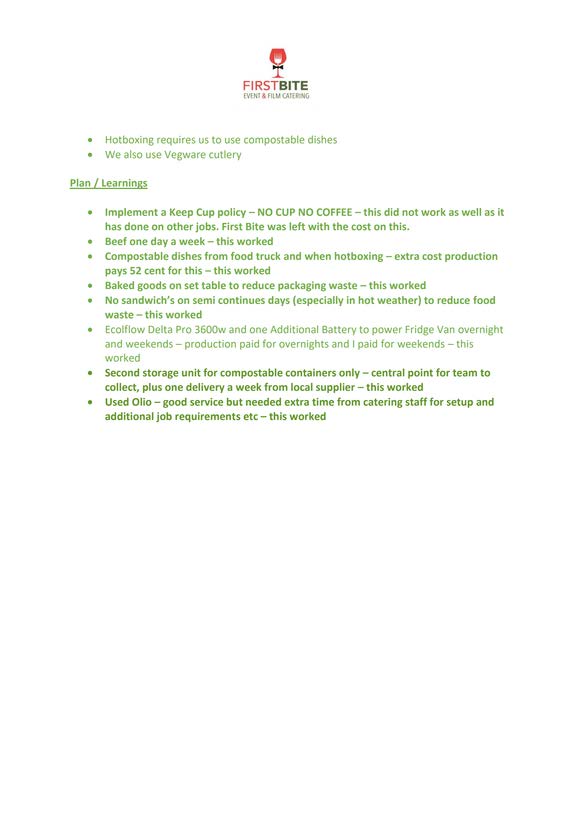
Fostering the channels of communication early in prep is the first line of action when it comes to implementing any sustainability measure. Therefore it was decided to have a pre-prep meeting alongside Heather Mackey, the owner of First Bite Catering, to discuss the topic of sustainable catering and prioritising reducing food waste on this production. In addition to using 100% compostables, sourcing local produce and limiting beef meals to once a week, the following areas were identified as vital points to meaningfully reduce edible food waste/ excess meals:
1. The importance of communication in relation to receiving accurate headcount numbers.
2. Mitigating measures to ensure that edible food/ excess meals are not deemed as waste.
Introducing Olio
Anyone on a film set knows that last minute changes are an every day occurrence and are inevitable, such as background artists no longer needed for a scene or sent home early. However, these occurrences not only indirectly impact logistics, costs etc. but they also carry emissions and edible food waste is not only a prime example but one of the most difficult to mitigate. Olio, a food donation service has been a leading solution to tackling this issue in the UK for the Film industry and recently launched their service in Ireland. Small Town, Big Story, with the support of Screen Ireland, was able to be one of the first productions in the Republic of Ireland to trial this service. By engaging this service we were not only planning to reduce emissions but also in a time of the rising cost of living, we were also ensuring our production had a positive social impact by helping feed those in need. Olio has achieved some fantastic results and emissions savings on other productions of a similar size and length, and has helped a broad range of communities, charities and homeless shelters. For these reasons, the service is an ideal mitigating solution for edible food waste.


First Bite Sustainability Policy
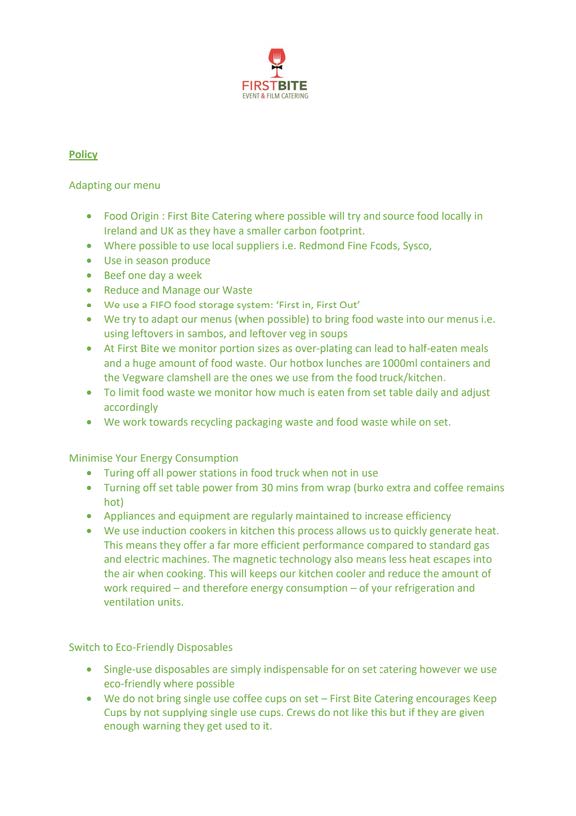
In addition to engaging a service to operate as a mitigating measure to edible food waste/excess meals, the production and the catering company also recognised the importance of incorporating as many measures internally and within current work processes to ‘design out’ food waste. While we were in the privileged position to engage a service like Olio, a solution that is well suited and equipped to service large-budget productions with massive numbers of crew, cast and background artists, it goes without saying that not all productions are in this position. For this reason, it is paramount that suppliers innovate and incorporate sustainable production practices into their work processes. One of the cornerstones of sustainability is that it is a just transition and for this reason other mitigating measures were also explored by the Sustainability Lead and First Bite which not only reduced emissions but were for the majority of the time also cost effective such as:
1. Ensuring that accurate headcount numbers were given
2. Using a FIFO food storage system: “First in, First out”
3. Adapting menus when possible to design leftovers into menus (i.e. using leftovers in sandwiches, soups etc.)
4. Monitoring portion sizes and avoid overplating
5. Monitoring how much is eaten from the set table daily and adjust accordingly
Click below for a look at First Bite's Sustainability Policy:
Results
Over the course of the production, Small Town, Big Story week by week consistently reduced excess meals and this is evident by our results. This was achieved by:
1. Creating a plan: we set up a whatsapp group chat with a member from the catering team, a representative from Olio, the volunteer collecting that day as well as the Sustainability Team to communicate collection times, number of meals to be collected etc.
2. Coupled by their sustainability policy, Catering now tracking edible food waste from the first day of shoot as “data”, developed a greater awareness and used this “data” to inform a more accurate headcount and thereby reduce food waste and design it out.
As a result, over time the daily amount of excess food waste became so minimal, with no more than five meals a day and some days none at all, that a more feasible and practical measure to mitigate any food waste was to encourage crew to take leftovers home. Especially compared to other jobs of a similar size, these results exceeded our initial expectations.


Key Takeaways
While many factors worked in our favour on Small Town, Big Story, such as having a Sustainability Team and not having huge numbers of Background Artists, it goes without saying that we significantly reduced excess edible food waste by accurately tracking the amount of edible food waste generated each day and treating it as “data” to inform decision-making to reduce emissions. While there are always unforeseen factors in the Film Industry, planning is the only way to manage any measure to the best of our ability and to reduce our impact.
However, every production is different and certain factors, such as having a large number of Background Artists or varying headcounts each day, could pose as challenges to sustainability. For this reason, mitigating measures to emissions that can’t be designed out are of the utmost importance. For productions like these, Olio is a logistically sound solution that couples emissions reduction with a meaningful positive social impact.
Communication and having a plan is key to a successful Olio partnership and we found their team were well equipped to servicing the Film & TV industry. For example, in regards to the storage of donations, Olio can take donations in hotboxes, containers with tin foil etc. but once cooked it must be stored either in a refrigerator or hotbox if not collected within the hour by the volunteer. This didn’t prove difficult in practice but it was important that this was communicated to the caterer and effectively strategised so that we could donate as much as possible.

First Bite’s robust Sustainability Policy and openness to adapting to reducing emissions on Small Town, Big Story was the biggest takeaway from this experience and illuminates how important it is to encourage and foster an environment to allow suppliers to innovate. Facilitating a meeting in early prep with the Catering Team alongside a dedicated Sustainability Team with the support of the Producers allowed for innovation to tackle food waste to take place.
A recommendation as a result of this experience would be to encourage all caterers to review their work processes and integrate edible food waste as a “data” point to track and incorporate it into their company policy. First Bite expressed the value of incorporating leftovers into menus, planning menus as well as organising preorders in advance and ensuring to only purchase what you need as key measures they have implemented to reduce edible food waste on productions. Lastly, exploring mitigating measures internally such as partnering with charities and homeless shelter in the locality, preparing food so that it can be donated according to legislation as well as encouraging staff/crew to take home leftovers are also cost-effective measures that can meaningfully reduce emissions and have a positive social impact, irrespective of budget size.
Credits
This case study was prepared by:
Alex de Valera, Sustainability Lead, Director of Ecoscope Ltd.
And approved by:
Anneliese O'Callaghan, Line Producer
Yvonne Burke, Production Manager
Will Poole, Production Executive, Playground
Noëlette Buckley, Head of Production, Playground
STBS Productions DAC
Claremont House Screen Hub Wicklow County Campus Claremont, Rathnew
Co.Wicklow A67 X566
Ireland/ Ashford Studios