scroll

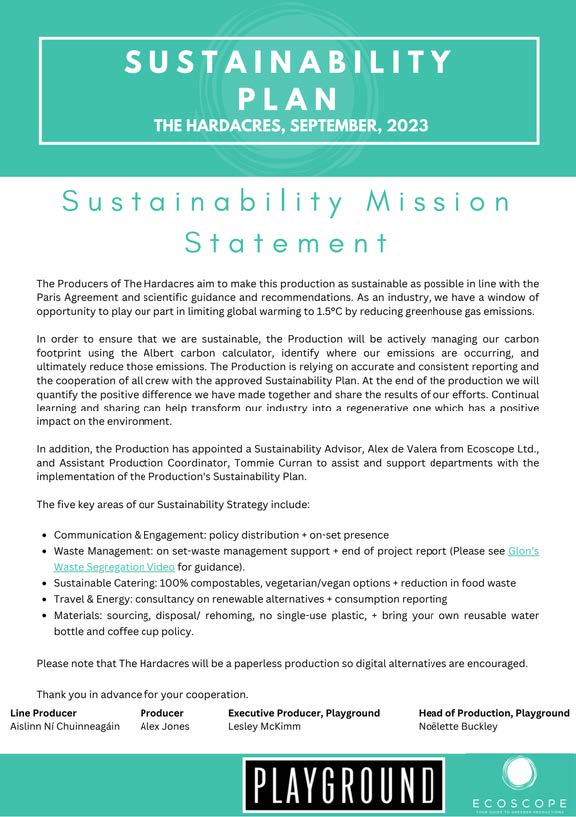
The Producers of The Hardacres, 2023/24 aimed to make this production as sustainable as possible in line with the Paris Agreement and scientific guidance and recommendations. The Production actively managed their carbon footprint using the Albert carbon calculator, identified where their emissions were occurring, and ultimately reduced those emissions. The Production relied on accurate and consistent reporting and the cooperation of all crew with the approved Sustainability Plan.
In addition, the Production appointed a Sustainability Advisor, Alexandra de Valera, from Ecoscope Ltd., and Assistant Production Coordinator/Sustainability Coordinator, Tommie Curran, to assist and support departments with the implementation of the Production's Sustainability Plan.
The five key areas of the Sustainability Strategy included:
- Communication and Engagement: policy distribution + on-set presence.
- Waste Management: on set-waste management support + end of project report.
- Sustainable Food: 100% compostables, vegetarian/vegan options + reduction in food waste.
- Energy & Travel: consultancy on alternatives + consumption reporting.
- Materials: sourcing, disposal/ rehoming + bring your own reusable water bottle and coffee cup policy.
The Production's total carbon emissions were 194.24 tonnes of CO2e. The Production's top sustainability highlights are as follows:
- Using renewable energy wherever possible, for example the use of HVO for the electrical and facilities generator.
- Using majority LED lighting (80-100%), using mains/tying into the grid, top of the range Stage 5 generators and the extensive use of battery power equipment as well as engaging a lighting company which was highly supportive of sustainability initiatives.
- The use of 19L water drums as opposed to single-use plastic bottles.
- The use of 100% compostables for Catering utensils. The Make Up, Hair, Costume, Art departments employing sustainable practices and environmentally friendly materials as much as possible.
- Renting the majority of costume.
- Majority of flights that took place were economy class and short-haul.
- Engaging a Sustainability Team early in prep with expertise in carbon reporting.
- Holding a WEEE day.
- Devising an extensive Asset Disposal Plan.


Communication and Engagement
The Production prioritised producing sustainably from the beginning of production which is reflected in the production's overall carbon footprint.
This was achieved by:
- The part-time Sustainability Advisor and APOC/Sustainability Coordinator being engaged early in production.
- Sustainability Plan and policy per department developed by the Sustainability Advisor alongside Producers. These were then approved and distributed to HoDs prior to Shoot Day 1.
- Key departments being contacted and assisted with the implementation of the sustainability policy by the Sustainability Team prior to Shoot Day 1.
- Attaching a Sustainability Crew Memo to the Call Sheet which communicated the production's goals of being a sustainable production to all crew members prior to Shoot Day 1.
- Having a APOC/Sustainability Coordinator and Sustainability Advisor throughout shoot dedicated to the implementation of the sustainability policy and to assist departments with carbon tracking for Albert.
Overall, crew were engaged on this production. Several departments requested consultation and feedback from the Sustainability team and meetings to discuss future developments and measures that could be implemented in their departments. Strategising a Sustainability Work Plan between the Sustainability Advisor and APOC/Sustainability Coordinator early in prep assisted immensely with workflow and facilitated streams of communication with departments. This was made possible by the continued support of Playground and the Production Team and their commitment to ensuring that this production was as sustainable as possible and strategically reduced emissions.
Click here to read the production's Sustainability Mission Statement.
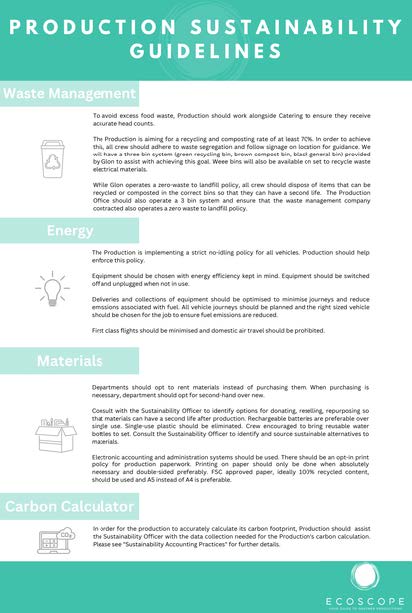
Click here to read the production's Sustainability Guidelines.
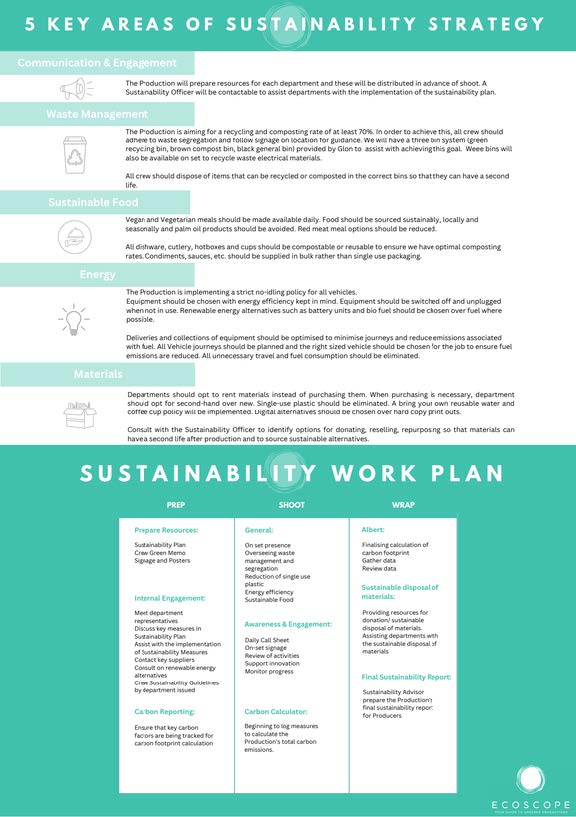
Click here to read the production's key areas for Sustainability Strategy and Sustainability Work Plan.
Waste Management
The recycling and composting rate on set was 64%. The total emissions associated with disposal were 0.3992 tonnes of C02e.
This was achieved by:
- All crew adhering to waste segregation
- Following signage on location for guidance
- Having crew members dedicated to the implementation of the sustainability policy and providing resources to crew to ensure optimal waste diversion results were achieved.
- The use of 19L water drums instead of single-use plastic and encouraging crew to bring in reusable water bottles from home.
- The use of 100% compostables by catering
Glon, the Waste Management company which operates a zero-waste to landfill policy, provided the production with a three bin system (green recycling bin, brown compost bin, black general bin) which assisted with achieving this goal.
Food and compost was sent to a commercial composting facility where it was processed to create a commercial compost product for farmers.
Recycling was sent to a Material Recovery Facility (MRF) where the materials are extracted and segregated.
General waste was sent to an incineration plant where it is burnt as a fuel to produce electricity. This is a waste-to-energy model.
By holding a WEEE day for crew, the Production also made every effort to recycle items that are usually difficult to recycle both domestically and commercially. As a result, 220kg of waste electrical goods were recycled.


Sustainable Catering
Emissions associated with catering accounted for approximately 24.91091 tonnes of CO2e. The production made it a priority to ensure that catering provided to crew was as sustainable as possible:
- Vegan meals were made available daily with the aim of reducing meat consumption.
- Food was sourced sustainably, locally and seasonally and palm oil products were avoided.
- All dishware, cutlery, hotboxes and cups were compostable to ensure optimal composting rates (see 1.2 and 1.5 for further details).
- Limiting beef as much as possible.
- Condiments, sauces, etc. were supplied in bulk rather than single-use packaging where possible
It is important to note that Hot Buns Catering has been as the forefront of employing sustainable catering practices and were one of the first caterers in the industry to switch to using 100% compostables as standard practice.
It is clear by comparing both pie charts beef meals carried the highest carbon emissions.


Energy and Travel
Emissions associated with energy usage accounted for approximately 81.6% of the production's total carbon emissions. Energy usage associated with filming spaces, i.e. generators, were 32.832 tonnes of C02e. Energy usage associated with Travel and Transport was 104.6064 tonnes of C02e. This is in line with what would be expected for a production's carbon footprint however, the production implemented the following measures to reduce emissions associated with energy usage as much as possible:
- The production implemented a strict no-idling policy for all vehicles.
- Equipment was chosen with energy efficiency kept in mind and switched off and unplugged when not in use.
In regards to Facilities and Location equipment, such as generators, towerlights etc., all ran on HVO (Hydrotreated Vegetable Oil) for the majority of the production. HVO reduces emissions by up to 90%. As a result of using HVO, there were carbon savings of approx 17.35 tonnes of CO2e which is the equivalent of driving 104,100km in a diesel car). The Facilities Manager also ensured to group HVO orders together across all departments to ensure transport emissions associated with deliveries were also reduced.
In addition to using HVO, the production engaged a lighting company, Apollo, which uses highly energy efficient and low energy equipment. Engaging a lighting company which was so supportive of sustainability initiatives helped the production reduce emissions. The Gaffer provided a kit list in prep which outlined the range of equipment and their sustainability credentials. Across the production, the Electrical department was able to use at minimum 80% LED lighting each shoot day, 100% on some shoot days, as well as battery units such as Instagrids, asteras, aputures, S30s, Lightmat spectrums etc. which reduced fuel usage considerably. When a generator was necessary, Apollo supplied a correctly sized 100kVa or 47kVa energy efficient Stage 5 generator. Apollo also used instagrid battery packs to power lights and sound on location and tried using mains/tying into the grid when possible. Their practical lighting in Cabinteely house ran off mains power.


Materials
Where possible, the Production ensured that all materials were from sustainable sources and that they were also disposed of sustainably. The total emissions associated with Materials during shoot were 35.2583 tonnes of C02e. The production adhered to the following guidelines:
- Departments prioritised renting instead of purchasing new. However, when purchasing was necessary departments prioritised using second-hand and sustainably sourced materials where possible.
- Departments consulted with the Sustainability Coordinator and Sustainability Advisor to identify options for donating, reselling and repurposing so that materials could have a second life after production.
- No VOC (Volatile Organic Compound) paints, adhesives and sprays were used and toxic materials were avoided. The production encouraged digital alternatives to printing and all paper was FSC/EU label.
- Departments consulted with the Sustainability Coordinator and Advisor to identify and source sustainable alternatives.
The Production team at every juncture prioritised sourcing materials sustainably and ensuring that they had a second life after production. For example, all consumables at wrap were donated to other productions and also supported a preexisting industry supplier by using facilities at Glon’s warehouse for storage upon wrap. The production also ensured to entirely eliminate single-use plastic by using water coolers in the offices and water drums with pumps on set which had a significant impact on the production's waste figures (See. 1.2 for further details). In addition, production also went out of their way to assist other departments being sustainable, for example when plants used as props were no longer needed, production actively encouraged crew to rehome them instead of them being diposed of so that they could have a second life.
In addition, the Hair & Make-Up Artists paid a considerable amount of attention to sustainable practices by using eco-friendly products as recommended by the Safe Cosmetics Campaign. Costume also prioritised using eco-friendly products. Seeing as The Hardacres was a period drama, this meant that the vast majority of costume were hires which helped the production reduce emissions. In addition, on wrap any leftover fabrics and cutting tables were also donated to other productions thereby upholding the principles of the Circular Economy. The Art department also made ample use of items already found at locations such as Victorian signs at the stables.


Conclusion
The Hardacres achieved great results in regards to the sustainability measures that were implemented. This was as a result of the genuine commitment of Playground, the Producers, the Production Team and the support and cooperation of crew to the Sustainability Plan and the Sustainability Departmental guidelines. It is important to note that engaging with Sustainability early in Prep and engaging crew dedicated to the implementation of the Sustainability Plan ensured that accurate carbon reporting was taking place as well as departments been given enough time and the opportunity to meaningfully innovate to reduce emissions.
In regards to waste management, achieving an overall 64% recycling and composting rate on-set was primarily due to the use of 100% compostables by Catering, the use of 19L water drums instead of single-use plastic, and the waste segregation resources distributed by the Sustainability Team. Given that Glon also operates a zero-waste to landfill policy, it should also be noted that no general waste was sent to a landfill. Recommendation for the future would be to engage a member of crew responsible for promoting appropriate waste segregation practices on-set in order to achieve a higher result.
In regards to sustainable catering, the production hiring a catering company which use 100% compostables, source locally and have high sustainability credentials were noteworthy. While it is also important to recognise that it would be counterproductive to tarnish crew rapport by eliminating preferred meal options, catering providing tasty vegan and vegetarian options plays a significant role in positively encouraging crew to make the more sustainable choice and ultimately assists the production in reducing its carbon emissions. Eliminating the use of beef or reducing it to once a week across all shoot days would be an effective way of reducing emissions further in the future.
Energy usage constituting approximately 81.6% of the production's overall carbon footprint is a positive result as this area usually accounts for between 60-85% of a production's overall emissions compared to other carbon footprints analysed previously by Ecoscope. The fact that mains power and battery powered equipment was prioritised, such as using Instagrid battery packs, asteras, aputures etc. and that the Electrical team was able to run their generator on HVO for a good proportion of the shoot significantly helped to reduce emissions associated with Filming Spaces. As a result, Filming Spaces accounted for approximately 16.9% of the production’s overall carbon emissions. By switching to HVO, there was a carbon saving of approximately 22.96 tonnes of CO2e which is the equivalent of taking 137,760km travelled in a diesel car off the road. It is important to note that HVO (Hydrotreated Vegetable Oil which reduces emissions by up to 90%), significantly reduces emissions however running on mains power that is on a renewable energy tariff reduces emissions further.
While it was attempted to run entirely off HVO for diesel powered equipment for the whole shoot, due to supply issues this was not possible which meant that emissions were slightly higher that if we were to have used HVO for the entire shoot. It would be a recommendation for the future to source more facilities and filming locations that run on a renewable energy tariff and have a 3 phase power set-up to reduce emissions further. Flights on average generally constitute the biggest proportion of carbon emissions on a production, however as the majority of flights were short haul and economy class on this production, this helped reduce emissions. In order to reduce emissions further in regards to ground transport, opting for Eco Taxis/ EV/ Hybrid vehicles and grouping as many journeys together, especially in regards to the Props runaround truck, is effective in achieving this however, the range needs to be improved on EV vehicles in order to satisfy the demands and needs of the industry so they can be used across the board. Incentives encouraging Crew and the Props Runaround to switch to HVO for diesel powered equipment, for example providing HVO fuel cards, could assist with this and work as a mitigating measure in the interim.
Renting materials and sourcing sustainable alternatives, as well as buying with the intention of reusing or donating, played a huge factor in reducing emissions on this production. The fact the majority was hired due to The Hardacres being a period drama was a hugely positive measure the production implemented. A well devised and thought-out Asset Disposal Plan was a noteworthy measure on this production. In addition, the Make-Up Artist’s commitment to sourcing sustainably, as well as Art department engaging in sustainable production practices throughout the shoot were commendable.
From these results, it is evident that when sustainability is prioritised and communicated early in prep, the appropriate measures implemented during shoot, and accurate reporting taking place in wrap, as outlined and communicated in the Sustainability Work Plan, excellent and positive results can be achieved.
Prepared by:
Alex de Valera, Sustainability Advisor Director of Ecoscope Ltd.
Approved by:
Aislinn Ní Chuinneagáin, Line Producer
Alex Jones, Producer
Lesley McKimm, Executive Producer, Playground
Noëlette Buckley, Head of Production, Playground
Hardacres Productions DAC
Admin Building
Irish Management Institute Sandyford
Dublin 16
D16 X8C3