Find more information on COVID-19 guidelines and filming in Ireland here.
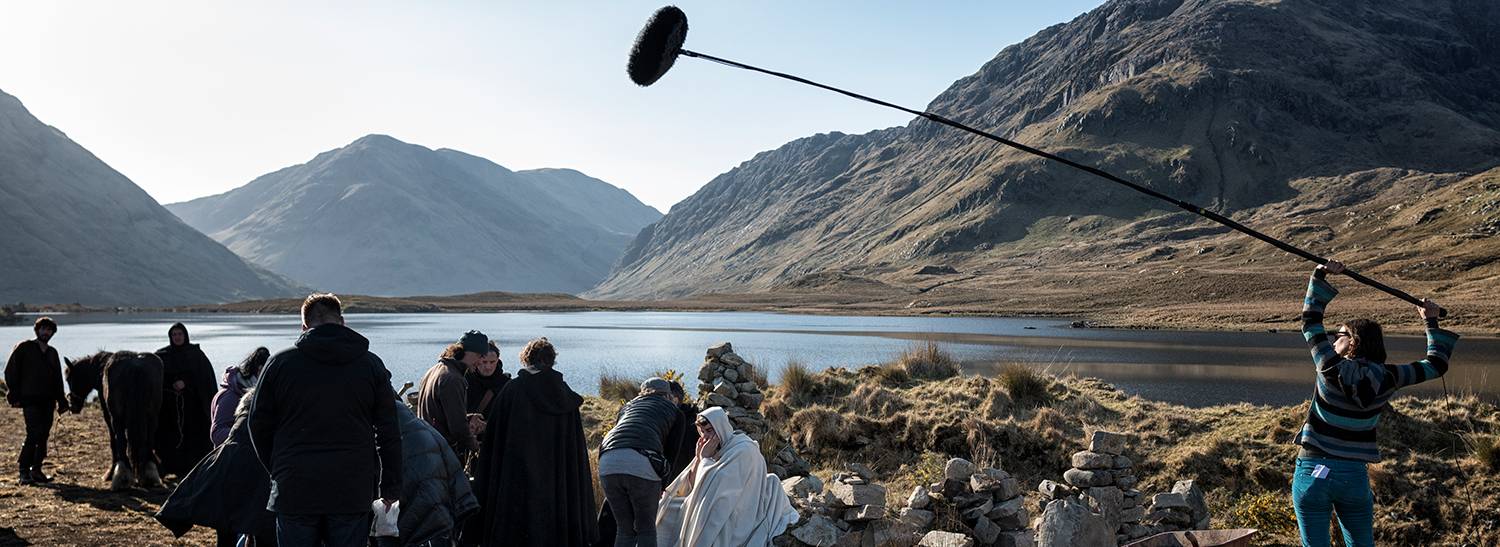
Ireland is a film friendly country. Our film, television and animation industry has experienced consistent Government support over the last two decades and has become a global success story.
The Inward Production team at Fís Éireann/Screen Ireland is here to offer you as much on the ground logistical support and advise on filming in Ireland as you need, to ensure your experience in Ireland is as productive as possible.
We also have a network of local film offices that will assist you with your film production throughout the entire country.
Please contact us at:
Inward Production Team
+353 91 561 398
inwardproduction@screenireland.ie
“Ireland’s regional film offices proved an invaluable resource throughout the Star Wars: Episode III –The Last Jedi shoot. From Donegal to Cork, we were offered crucial on-the-ground assistance with access and permits, along with essential local insight. We received an all-inclusive service, complete with discretion and absolute professionalism.”
Mally Chung, Location Manager, Star Wars: Episode 8 – The Last Jedi
Filming
- We recommend using a professional Location Manager on your production when filming in Ireland. They will help you to find and secure locations to be used, obtain all fire, police and other governmental permits, and coordinate the logistics for your production. They will also provide a great source of local knowledge. The Location Guild of Ireland list members for your convenience.
- If you are filming on private property, you will require the owner’s permission and consent. It is normal practice to have a location agreement signed by both the Production Company and Owner prior to filming. Appropriate insurances should also be in place.
- If intending on filming in a public location you will need to obtain appropriate licences from the relevant local authority or any other authority in control of such spaces. It is recommended that the production company informs An Garda Síochána of all details of filming on the street or in a public place. This includes any staging of crimes, accidents or use of firearms and special effects if they take place in the public domain.
- The production company should ensure that all those affected by filming are consulted and informed of production arrangements in advance.
- There will be times when it is prudent to have members of An Garda Síochána in attendance to ensure efficient traffic management while filming on location. A Location Manager or other designated crew member is required to communicate with the Garda Síochána Commissioner and local council, who will advise on the need for Garda assistance at any given film location.
- Garda personnel assigned through the Office of the Garda Assistant Commissioner are at all times operating under the direction of Garda Management and not the production company that requested Garda assistance. All non-public duty Garda costs incurred will be borne by the production company. Details of all charges are available upon request from the Office of the Garda Assistant Commissioner.
Road Closures
- A road closure should be applied for if you wish to divert traffic from a road or will require the road cleared for a scene.
- A minimum of 4-5 weeks’ notice should be given for road closures applications and must be accompanied by a Traffic Management Plan. Please contact the local office for advice in the area you are filming.
Health & Safety
- The Producer must comply with all Health and Safety Legislation, the Safety, Health and Welfare at work Act 2005, Health and Welfare at work Act (Construction) 2013, Health and Welfare at Work Act (General) 2007, Fire Services Act 1981 and 2003. All regulations made there under, and all other relevant legislation, regulations and approved Codes of Practice, to ensure the safe running of this production.
- The health and safety of cast, crew and public must be safeguarded at all times. It is the responsibility of the production company to ensure safety standards are maintained at all time and filming should be stopped with immediate effect if it is unsafe to continue filming.
- Crew members and production personnel working on site must wear the correct personal protective gear appropriate to their tasks and duties on location.
- Further guidance on health and safety across all departments on a production can be found in our Health & Safety Guidance Document.
More detailed information on filming in Ireland can be found in our toolkit.
Garda
It a recommended that you inform local police for ALL exterior location filming, which for example, for any filming in a public place in Dublin is the Garda Assistant Commissioner, Dublin Metropolitan Region, Harcourt Street Headquarters. Once you have contacted the relevant Local Authority to film, they will normally request that you inform local police.
Your Location Manager is best placed to make these contacts on behalf of a production.
You can find direct contact information for each station here.
It is essential that you contact the Garda representative, if you are featuring:
• Use of firearms (to include prop/replica firearms in interior or exterior locations)
• Re-creation of crimes
• Nudity or perceived nudity
• Fake Emergency Services vehicles (Garda, Defence Forces, Ambulance, Fire Brigade etc.)
• Fake Emergency Services uniforms (Garda, Defence Forces, Ambulance, Fire Brigade etc.)
If there are stunts taking place or management of traffic flow is needed then police supervision may also be required, in addition to permission from the local Authority.
If you are filming with any kind of weapon or replica weapon (even if you are filming inside a private location) it is essential that you contact the police before filming takes place.
Aerial
Flight requests and permit applications must be submitted to the Irish Aviation Authority and the process can take up to 3 weeks. Information on permitting can be found on the IAA website here.
Drone Use
All drones over 1kg in weight must be registered with the Irish Aviation Authority. Registered drone operators can be found on the IAA’s website here, along with other useful information relating to the operation of Drones for filmmaking purposes.
Restrictions include never operating a drone:
• If it will be a hazard to another aircraft in flight
• Over an assembly of people
• Farther than 300 m from the person operating the drone
• Within 30m of any person, vessel or structure not under the control of the person operating the drone
• Closer than 5km from an aerodrome
• In a negligent or reckless manner so as to endanger life or property of others
• Over 400ft (120m) above ground level
• Over urban areas, in civil or military controlled airspace
• In restricted areas (e.g. military installations, prisons, etc.)
• Unless the person operating the drone has permission from the landowner for take-off and landing..
These restrictions and other helpful guidelines can also be found on the IAA information leaflets available as downloads below.
Water
- The local film office should be contacted ahead of any planned water filming. You can find full contact details for the relevant local office here.
- As a general rule, safety must be a priority for all filmmaking involving working on or near water. Some guidelines for maintaining a safe work environment include:
- Ensure you are working a sufficient distance from the water’s edge.
- Wear suitable flat robust shoes with non-slip soles.
- Be aware of trip hazards at the water’s edge and remove where possible.
- Understand the local emergency plans. Develop rescue plans if there is a risk of falling into the water.
- Wear life jackets or buoyancy aids where there is a risk of entering water. Choose the correct life jacket for the conditions eg, manual or automatic inflation and make sure it is fitted correctly.
- Wear waterproof clothing suitable for location / weather conditions and take spare clothes are taken if likely to get wet.
- Use battery powered equipment wherever possible. Where mains power is used, ensure cables, sockets etc. are suitable for the environment (Ingress Protection, IP, rated for water) and connected through a residual current device (RCD).
- Brief crew to ensure any cuts or abrasions are covered with waterproof dressings to avoid any risk of infection
- Ensure the team’s immunisations are up to date and staff knows the signs and symptoms of leptospirosis or Hepatitis A when working on or near flood waters, sewers and rivers.
- Plan breaks and hot drinks in warm places, if weather is wet / cold.
- Make yourself familiar with the filming area and obstacles/trip hazards such as hooks, nets, boom and ropes and avoid filming under boom when the boat is in sail.
- Break equipment down into manageable sized parcels for loading onto boats.
- Do not climb to height on boat, e.g. filming from crow’s nest, yard arms or mast.
Canals/Rivers/Lakes
Waterways Ireland is the governing body for inland navigable waterways such as canals, rivers and lakes in Ireland. These include the he Barrow Navigation, the Erne System, the Grand Canal, the Lower Bann, the Royal Canal, the Shannon-Erne Waterway and the Shannon Navigation.
You can find full information on permits and safety requirements for filming on inland waterways on the Waterways Ireland website here.
The online film permit form can be found here.
Contact Information:
Waterways Ireland Press Office
+353 (0)71 9650560
Email: katrina.mcgirr@waterwaysireland.org
Sea/Coastlines
The Royal National Lifeboat Institution (RNLI) is a volunteer lifeboat service for sea and coastlines in Ireland and the UK. They can provide information and advice on water safety and their website provides many resources in relation to water saftey which you can find here.
Contact Information:
Niamh Stephenson - Public Relations Manager
+353 (0)87 125 4124
Email: Niamh_Stephenson@rnli.org.uk