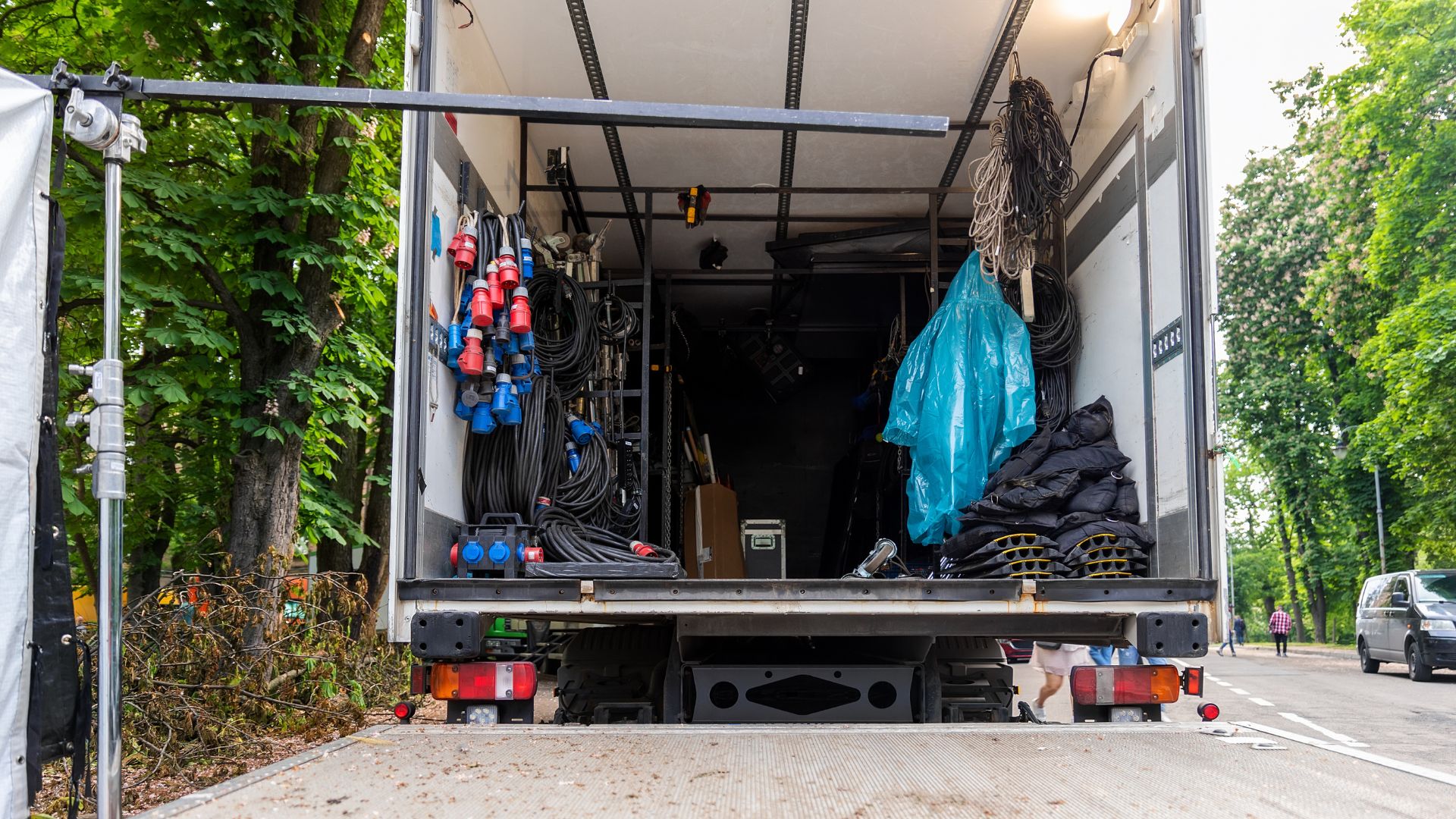
5.1 Trucks/Heavy Goods Vehicles
Trucks used on film productions typically transport facilities and equipment used by the shooting crew. They generally only move to and from filming locations and can stay at the same location for days. They tend to be fuelled in bulk with deliveries being brought to them at their location.
Recommended
- Trucks powered with Euro 5 or Euro 6 engines should be chosen over older more polluting options.
- Trucks should be fuelled with HVO in preference to diesel.
5.2 Vans/Light Goods Vehicles
Vans used on film productions can either be used to transport equipment used by the shooting crew, or they can be used for collecting and delivering goods and equipment to and from the stores/locations.
Recommended
- Vans powered with Euro 6 engines should be chosen over older more polluting options.
- Vans fitted with speed limiters should have them set below 100km/h (to maximise fuel efficiency).
- Vans should be fuelled with HVO where possible.
5.3 Buses and Taxis
Buses are typically used to transport cast between home and the unit base, and between the unit base and set. Buses are also used to transport crew between the unit base and set. Taxis are typically used to transport cast between home and the unit base, and between the unit base and set.
Recommended
- Buses powered with Euro 5 or Euro 6 engines should be chosen over older more polluting options.
- Buses should be fuelled with HVO where possible.
- Taxis should ideally be battery electric vehicles (BEVs) or plug-in hybrids (PHEVs).
- Charging facilities should be provided at the production office and unit base to enable BEVs and PHEVs to be topped up when standing by.
- HVO fuel should be used in preference to diesel fuel for vehicles with diesel engines.
5.4 Personal Transport
Many crew members in the art, set dec, props, costume, locations, production and construction departments use personal vehicles for work and get paid a car allowance/have their work-related fuel paid for by the production. These vehicles are a significant source of emissions on a production.
Recommended
- Measures to encourage the use of low/zero emissions vehicles or low emissions fuel by crew should be identified and implemented.
- Charging infrastructure should be provided at the production office, unit base, stores and workshops to enable BEVs and PHEVs to be charged.
5.5 Air Travel
Air travel is one of the most polluting forms of transport per passenger kilometre travelled. Business class is twice as polluting as economy class or charter flights due to fewer passengers being carried on the flight.
Required
- Air travel should be limited to essential journeys only.
Recommended
- When air travel is unavoidable, passengers should fly economy class.
5.6 Public Transport
Public transport tends not to work well for film crew due to their long days and their travelling to remote and random locations from day to day.
Recommended
- Where possible, trains and buses should be used to transport cast and crew to regional locations rather than using a taxi or limousine.
5.7 Off-road transport
When filming in remote areas or areas where trucks cannot access or be facilitated, the film industry will hire in tractors and trailers, jeeps and trailers or buggies and trailers to transport people and equipment from the unit base to set.
Recommended
- Off-road vehicles should be fuelled with HVO where possible.
- Opportunities to use battery/hybrid battery off-road vehicles should be explored.