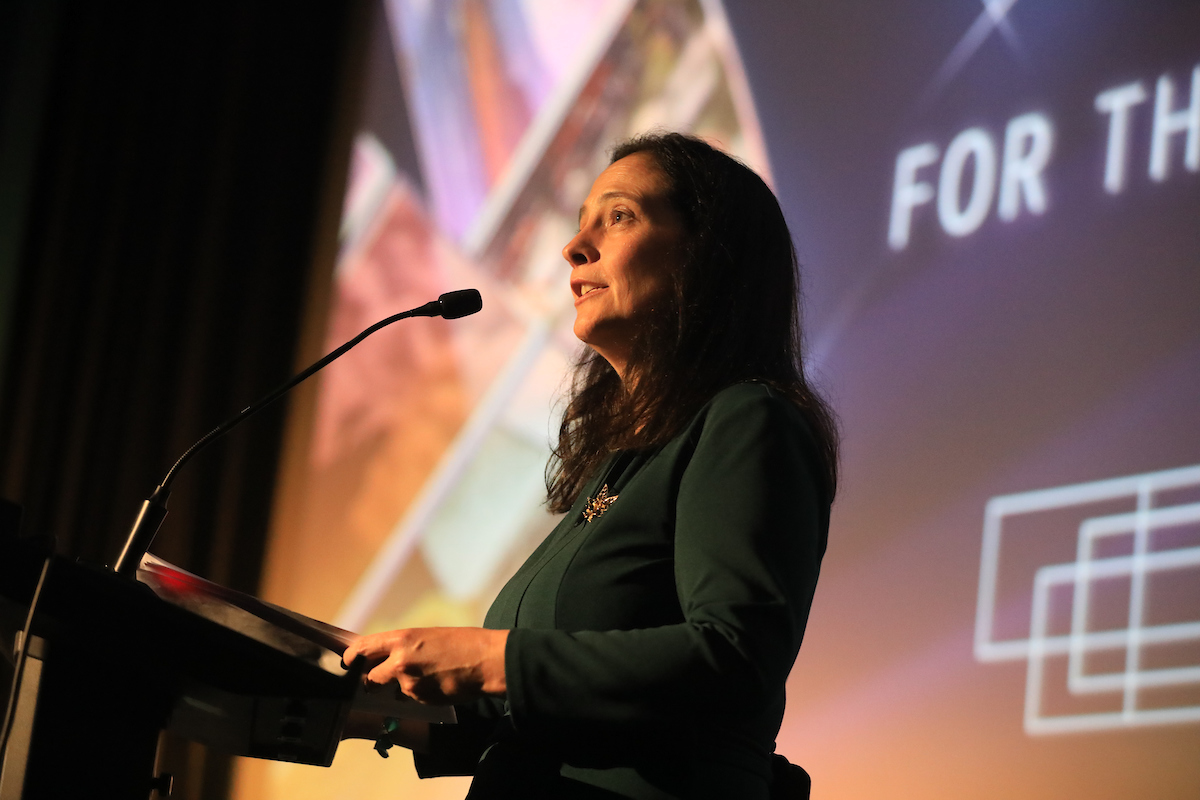
Minister Catherine Martin T.D.'s Keynote Address to the Irish Screen Industry
Dia daoibh a chairde. Ba mhaith liom fáilte a chur romhaibh go léir. Tá an-áthas orm a bheith anseo inniu.
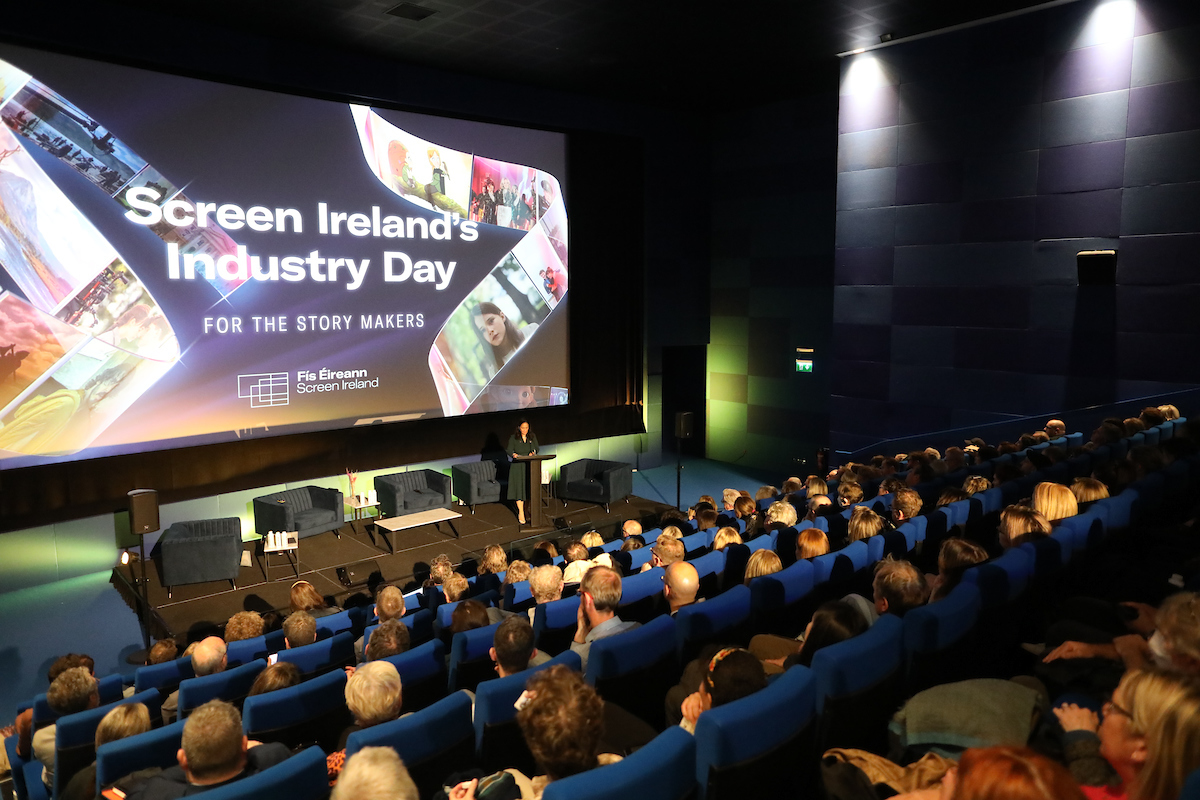
It is great to see such a big crowd for this Screen Ireland Industry event, and a special thank you to Susan and Désirée and all the Screen Ireland team for inviting me.
The Government recognises the enormous success of the Irish screen industry to date, and the economic and cultural power that this sector produces both at home and abroad. The industry’s resilience, innovation and mettle has been proven over years of growth – both in terms of achievements and challenges.
When it comes to Sustainability, it is so important for every industry to reduce emissions and I know that many producers have risen to the challenge and introduced green production practices including reducing the use of paper and plastic bottles on set and the wide use of the Albert carbon calculator to measure the carbon footprint of productions.
I know that Screen Ireland’s Sustainability Plan, launched in April 2022, is dedicated to establishing a stable foundation to ensure that further growth is responsible and sustainable but also the growth of a kinder, fairer industry with diversity, equity and inclusion at its heart. I commend in particular, the objective that Screen Ireland will be carbon-neutral by 2025 – a full 5-years ahead of the Government’s target of 2030.
Section 481 Film Relief has been a cornerstone of the Irish screen industry since its implementation. Its legacy speaks for itself both in terms of discovering and supporting new Irish voices, as well as showcasing Ireland’s power as an international partner and a cultural force across film, television and animation.
The economic value of Section 481 is also important in what it brings to our industry in terms of infrastructure, upskilling and further training for crew.
The extension to Section 481 in the Budget last week beyond the current end date of 2024, until December 2028 will give a lot of certainty and is very welcome news for the sector.
€7.3m was also announced last week to allow TG4 to continue to fulfil its vital role in ensuring the provision of high-quality Irish language audio-visual content, serving our Irish-speaking communities, and supporting regional creativity and content production.
This increased funding includes a €3.3m provision which will support the launch of a new dedicated Irish language children’s channel, Cúla4, to enhance services for younger audiences.
It is expected the channel will include a children’s news service, education and entertainment content, drama, Irish animation, and will reflect the diverse backgrounds of children living in all parts of Ireland, but particularly in Gaeltacht and Irish speaking communities.
This increased funding is hugely significant, not only in terms of Irish language programming, but in the role played by TG4 in the delivery of the Government’s 20-Year Strategy for the Irish Language. This will enable TG4 to better serve Irish-speaking communities, and provide increased support to our regional creative companies.
The A.V. industry has been one of the success stories of the past few years. Training and skills development will continue to be a strong focus in the sector.
I was pleased to announce additional Budget funding of €1m for Screen Ireland which will ensure the continued success and growth of this internationally renowned industry into the future and to bolster support for indigenous productions.
2021 was a record-breaking year, an extraordinary achievement post-Covid, which further demonstrates the industry’s resilience and innovation.
The Irish screen industry provides a tangible economic benefit to our country, through jobs, skills development, regional development and production spend on local goods and services.
There is an even more essential cultural value in supporting Irish creative talent, telling Irish stories on screen, and connecting with audiences at home and around the world. In uncertain times, it is the artist we turn to as a guide. They provide us with shared experiences that remind us of the importance of identity, community and belonging, through the stories they tell.
In film, the Cine4 scheme has produced incredible feature film work in the Irish language, from the sweet and heart-warming recent release ‘Róise & Frank’ to Colm Bairéad’s beautiful film ‘An Cailín Ciúin’, a box office record-breaking milestone for Irish language cinema.
Aithním an tábhacht a bhaineann le scannáin Ghaeilge mar léiriú ar chultúr na hÉireann agus chun an cultúr sin a chur chun cinn don lucht féachana sa bhaile agus thar lear. Is deiseanna iontacha iad tionscadail Ghaeilge i bhfianaise méadú ar an éileamh domhanda ar léiriúcháin áitiúla teanga ardleibhéil.
The growth of local Irish TV drama has almost tripled in production spend since Screen Ireland began to support the sector with development funding in 2015 and production funding in 2019.
I visited Cartoon Saloon and Lighthouse Studios in Kilkenny during the summer and I know the animation industry in Ireland continues to innovate and solidify its reputation as a global powerhouse, reaching young audiences around the world.
In the past 15 years, Irish post-production and Visual Effects (VFX) has become a leading hub for large scale productions, underpinned by a highly-skilled local talent pool to call upon. Nominated for BAFTAs, Emmys and VES Awards, Irish VFX work is globally recognised, competing at the highest levels internationally.
Audiences at home and abroad are the key to our cultural power. This year, I was delighted to launch ‘Where to Watch’, a new online service from Screen Ireland designed to help audiences discover how they can watch Irish film, TV drama, animation and documentary, from anywhere in the world.
I mentioned ‘An Cailín Ciúin’ a few moments ago and a key theme from that film is the beauty of care, and what can blossom when attention and support is given to someone in need of it.
Much of the film’s meaning is in what is said and what is unsaid – but what is striking is how the most meaningful communication can be in simple, everyday acts that make a profound impact on both the giver and the receiver.
In that same theme of speaking and listening, documentary makers around the country are telling powerful stories about real-life trailblazers and icons in Irish society - whether it is paying tribute to the power of a voice, both on stage and off, in Sinead O’Connor in ‘Nothing Compares’, or the strength in speaking out, in the Vicky Phelan documentary ‘Vicky’, or the quiet influence of educators listening to their students, in ‘Young Plato’.
Filmmakers, artists and storytellers are our guiding lights in uncertain times, and we have seen that sentiment proven beyond a doubt, extending to the nature of how the creative industry, and the screen industry in particular, works together and respond to crisis.
This is an industry that could not exist without strong relationships, collaboration and a pull-together attitude – and these values are represented, not just in the success of the industry to date, but in the stories they’ve told that will leave their mark for future generations.
‘For The Story Makers’ is Screen Ireland’s ethos - one that represents the full breadth of the talents and diversity of contributions that make up even one production, as well as an entire industry. The Story Makers include: directors, screenwriters, producers, cinematographers, Heads of Department on set, highly skilled crew, industry craftspeople and professionals, along with new entrants and diverse and emerging creatives with stories just waiting to be told.
Screen Ireland’s support is designed to give attention and support to the industry at all levels, from new entrant to company leader and from crew to creative.
I had the opportunity in May this year to showcase and promote the Irish screen industry during a trade mission to Los Angeles, organised by Screen Ireland. The purpose of the mission was to meet with senior executives and build on already strong international partnerships.
By updating key industry partners on the continued evolution and success of the sector in Ireland, its potential for growth, and plans for additional production infrastructure, we were able to emphasise and continue the ongoing Government support for the Irish screen industry.
I’m sure some of you are probably attending the London Film Festival later this week and I understand that the European premiere of ‘Aisha’ will take place on Thursday as well as the World premiere of the animation ‘My Father’s Dragon’ on Saturday, so good luck to all involved.
Before I hand you back to Susan, I want to say a huge thank you to each and every one of you and I remain committed to supporting the Irish screen industry and will continue to engage extensively with Screen Ireland and other Industry stakeholders on issues important to the sector.
In the midst of ongoing uncertainty, we have a real opportunity to seize on the global demand for screen content and continue to grow the sector further.
Tá súil agam go mbainfidh sibh taitneamh as an gcuid eile den lá. Go raibh maith agaibh.